Devon · EX3
Roof inspection in Topsham
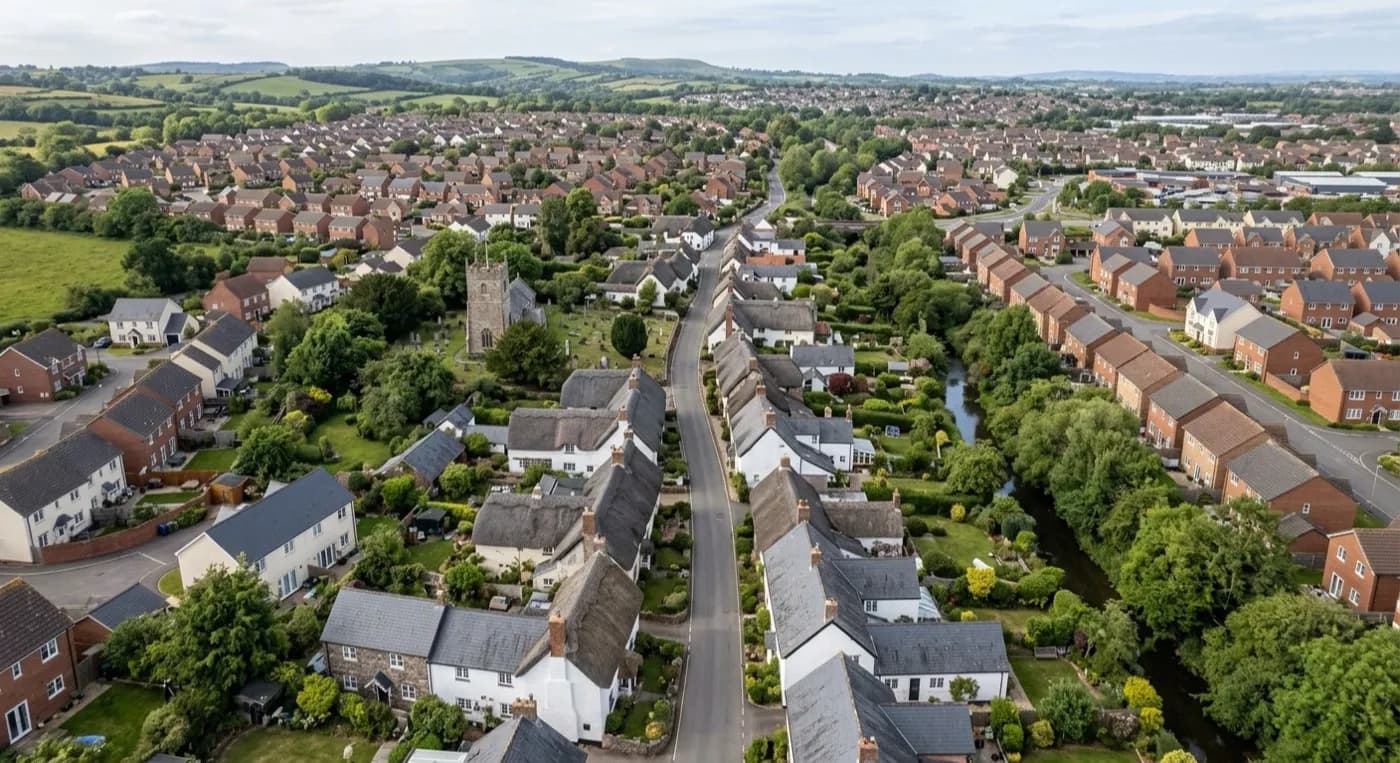
A roof inspection in Topsham, where listed merchant houses and Dutch gables on narrow estuary streets carry more lead work than a standard Devon roof.
A merchant town's roofscape
Topsham's historic core, built on wool trade money, is one of the more complicated stretches of roof anywhere in this coverage area. The merchant houses along the Strand and Fore Street carry curved and stepped Dutch gable ends, tall narrow frontages, and roof planes that meet at angles a modern builder would rarely draw, with slate as the dominant covering and a substantial amount of lead: valleys, soakers, flashings and box gutters, much of it hidden behind parapets.
A high proportion of these buildings are listed, which changes what can be done about a finding but does not change what needs checking for one to be found in the first place.
Away from the historic waterfront, Topsham also carries more conventional Victorian and 20th century housing on its outer streets, which needs the standard checklist for buildings of that age rather than the specialist attention the merchant houses require.
Flashings and valleys before anything else
On a roof this complicated, flashings and valleys are where the inspection earns its keep, since box gutters and soakers hidden behind a parapet are exactly the kind of feature a ground level look cannot assess at all. Chimney stacks come a close second, given how many of these merchant houses carry multiple original stacks.
The estuary air corrodes fixings faster than a couple of miles inland, so a slate that has been sound for a century can slip because the nail behind it has finally gone rather than because the slate itself has failed.
Where a Dutch gable end meets the main roof slope, the junction is often more elaborate than a standard hip or verge, and checking it properly usually means getting close enough to see individual lead dressings rather than relying on a general impression of the gable's condition from a distance.
A listed building's own version of the access question
Much of old Topsham is unsuitable for a scaffold lorry: the Strand and the lanes off Fore Street are narrow, parking is contested, and several stretches restrict vehicle access altogether. An inspection reaches the ridge, the gable and the back slope without a pole going up, which matters twice over on a listed building, where any physical contact with historic fabric is its own conversation with the conservation officer before a repair is even discussed.
Booking it in
For a listed building, it is worth mentioning the listing when booking, since the report can then be written with an eye to the kind of detail a conservation officer or heritage consultant might later want to see.
Topsham's estuary tides affect access along parts of the waterfront at certain times, and a visit is generally planned around a state of tide that keeps the lowest-lying launch points clear.
The Strand's popularity with visitors on fine weekends is worth factoring into timing too, since a quieter weekday visit generally gives a clearer run at the narrower lanes than a busy Saturday afternoon in the summer months.
For a property that has recently changed hands, a Topsham buyer weighing up how a roof this complex should be checked usually finds the answer easier once the seven areas are set out plainly, since it turns an intimidating, architecturally unusual roof into a specific, checkable list rather than a general unknown.
What the report is used for here
For a listed building, the report is often kept on file for years rather than acted on immediately, since it establishes a dated baseline that a conservation officer, an insurer or a future buyer can all refer back to, even where nothing found requires urgent attention.
Behind the survey
What Topsham clients are actually buying
Seven areas, checked in order
Tiles and slates, ridges and hips, valleys, flashings, chimney stacks, gutters and outlets, and any flat section, checked in the same order on every property where they apply.
CAA registered
Operator ID and Flyer ID held, plus the A2 Certificate of Competency. Every flight is planned to the rules that apply to the site, and the paperwork is available before the visit if a solicitor, agent or insurer needs it.
100 megapixel camera
A DJI Mavic 4 Pro with a Hasselblad camera and 6K video. The resolution is what lets the inspection stand off the building at a safe distance and still show a hairline crack in a single tile.
Insured with Coverdrone
Full commercial cover for the operation. Certificates go to solicitors, agents and insurers as a matter of course, without anyone having to chase for them.
Nearby
Also covered around Topsham
- ExmouthA roof inspection in Exmouth, where unbroken salt-laden south-westerlies off the Channel work on roof fixings faster than anywhere inland.
- Budleigh SaltertonA roof inspection in Budleigh Salterton, where large, long-held Victorian and Edwardian houses and outlying thatch make regular checking worthwhile.
See what's checked
Book an inspection in Topsham
Send the address and what is worrying you. Sam Hembury will come back with a fixed price and the next slot that suits the weather.