Devon · EX2, EX4
Roof inspection in St Thomas
A roof inspection in St Thomas, where low ground by the Exe and a mix of Victorian terrace and later estate housing make a dated record worth having.
A district split by the river and the railway
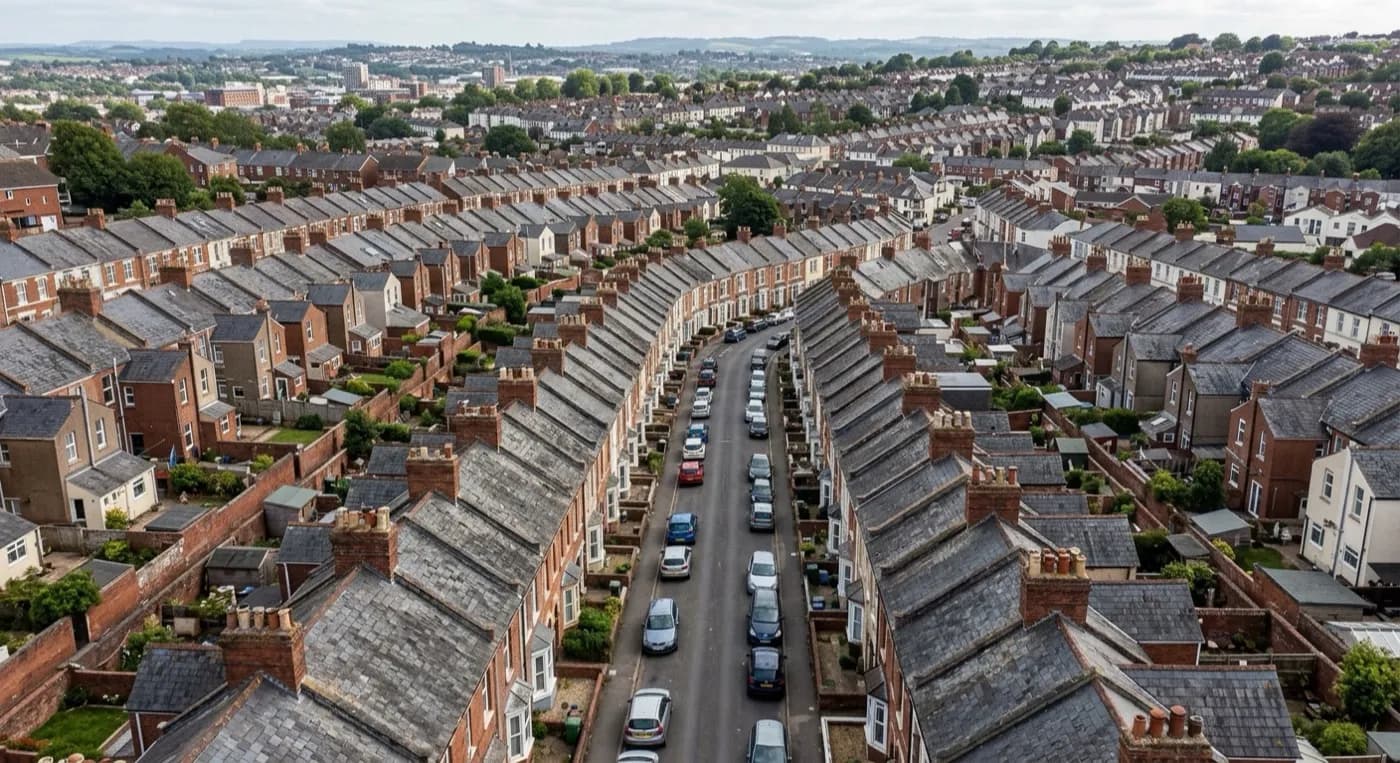
St Thomas sits on the west bank of the Exe, and it reads as two different neighbourhoods depending on which side of the old station you are standing on. Close to Cowick Street the housing is Victorian terrace, similar in age and form to Heavitree across the water. Further out towards Marsh Barton and the ring road it becomes post-war and more recent estate housing, concrete tile on shallower pitches.
What both halves share is proximity to the river on low ground, which is unusual for an Exeter district and worth being clear about before deciding what an inspection here needs to cover.
The area around the racecourse, on higher ground above the rest of the district, is a partial exception: the housing there sits well above the flood plain and behaves more like a typical inland Exeter suburb, which is a useful distinction to make before assuming every St Thomas property faces the same set of considerations.
Flat sections and gutters over the older stock
On the Victorian terrace stock, the pattern is familiar: ridge bedding reaching the age it starts to open, and valleys at the rear extension junctions silting up. What is different about St Thomas is how many properties carry a later flat-roofed rear addition over a kitchen extension, which puts flat roof condition on the list far more often than in a purely Victorian district.
On the newer estate housing further out, gutters and outlets are the area worth the closest attention, because shallower modern pitches move water off the roof faster and a partially blocked outlet backs up sooner than it would on a steeper Victorian slope.
Chimney stacks on the terrace stock are shared in the same way as Heavitree's, and given the age of the housing here, flaunching around the base of those stacks is frequently original and worth checking as a matter of routine rather than only when a leak has already been noticed indoors.
Why a record matters more here than average
The low ground by the old station has flooded before, and where ground level flooding has happened, having a separate dated record of roof condition is useful: it keeps a roof related insurance question distinct from a flood related one rather than the two getting muddled together after the event.
For anyone in St Thomas trying to work out how to get a roof properly checked, that separation, ground level flood risk against roof level condition, is usually the actual question underneath the more general one.
Booking it in
Marsh Barton's mix of trading estate and residential streets means access varies considerably within St Thomas itself, and a short note on which part of the district the property sits in helps plan the visit around the right take off point rather than assuming one approach fits the whole area.
Properties near the racecourse and higher ground tend to book inspections on a more routine, scheduled basis, while properties on the lower ground closer to the river more often book after a specific concern, whether that is a stain appearing indoors or a flood event nearby. Both are equally straightforward to arrange around.
What the report is used for here
A St Thomas report tends to end up in one of two conversations: with an insurer settling a claim that touches both flood and roof damage, or with a buyer's solicitor during a purchase on the lower, flood-adjacent streets. Both readers need the same thing, a dated, specific account of what the roof itself was doing on the day it was checked, kept apart from anything happening at ground level.
For the newer estate housing further from the river, the more common use is straightforward maintenance planning: knowing whether a gutter needs clearing this year or can reasonably wait, which is a smaller decision but still one that benefits from an actual look rather than a guess from the pavement.
Behind the survey
What St Thomas clients are actually buying
Seven areas, checked in order
Tiles and slates, ridges and hips, valleys, flashings, chimney stacks, gutters and outlets, and any flat section, checked in the same order on every property where they apply.
CAA registered
Operator ID and Flyer ID held, plus the A2 Certificate of Competency. Every flight is planned to the rules that apply to the site, and the paperwork is available before the visit if a solicitor, agent or insurer needs it.
100 megapixel camera
A DJI Mavic 4 Pro with a Hasselblad camera and 6K video. The resolution is what lets the inspection stand off the building at a safe distance and still show a hairline crack in a single tile.
Insured with Coverdrone
Full commercial cover for the operation. Certificates go to solicitors, agents and insurers as a matter of course, without anyone having to chase for them.
Nearby
Also covered around St Thomas
- AlphingtonA roof inspection in Alphington, a former village on the Alphin Brook flood plain now ringed by estate housing towards Marsh Barton.
- ExwickA roof inspection in Exwick, across the river from the city centre, where a riverside flood plain meets a hillside estate rising towards Exwick Heights.
- IdeA roof inspection in Ide, a conservation village on Exeter's western edge, with a concentration of thatched cob and stone cottages along one street.
See what's checked
Book an inspection in St Thomas
Send the address and what is worrying you. Sam Hembury will come back with a fixed price and the next slot that suits the weather.