Roof Inspection Exeter
The Inspection
Seven areas of a roof, checked in the same order on every visit, then written up in plain language within 48 hours. The drone is how the ground gets covered.
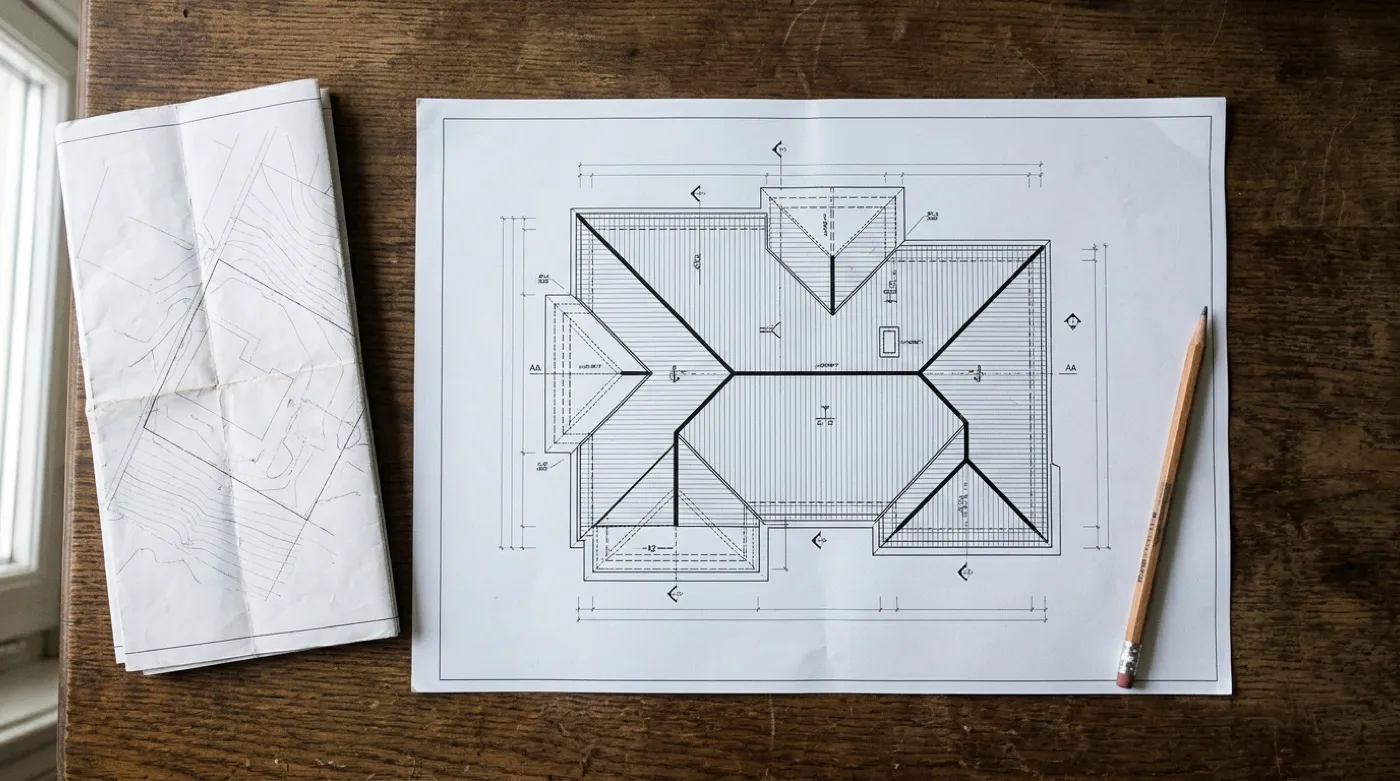
A roof inspection is not one look at a roof. It is seven separate checks that happen to be carried out on the same visit: the tiles or slates, the ridge and hips, the valleys, the flashings, the chimney stacks, the gutters and outlets, and any flat section. Each one fails for a different reason, at a different rate, and a survey that skips one because a ladder could not reach it is not a complete inspection, whatever the invoice calls it.
The aircraft solves the access problem. It reaches the ridge of a three storey Victorian terrace and the far corner of a hipped roof on a cul-de-sac semi in the same visit, without a pole going up against the house. That is useful, but it is a means, not the product.
The product is the written report. What was checked, what was found, where it is, and how urgent it looks. Written so a homeowner can read it without translating it, and specific enough that a roofer, a surveyor or an insurer can act on it without a second visit to work out what was meant.
What is included
- Tiles and slates: the covering itself, cracked, slipped, or eroding fixings
- Ridges and hips: mortar bedding and dry fix systems where roof planes meet at the top
- Valleys: the point where two slopes meet and water concentrates
- Flashings: the lead or flexible detail sealing every junction and abutment
- Chimney stacks: flaunching, pointing and the flashing at the base
- Gutters and outlets: where water is meant to leave the roof, and where it silts up instead
- Flat roofs: membrane condition, blistering, and standing water after rain
- A written report within 48 hours with annotated images and full resolution originals
Why the order matters more than the aircraft
A survey that starts with whatever is easiest to see tends to finish the same way: thorough where the access was easy, thin where it was not. Working through the same seven areas on every property, in the same order, is what stops a hard to reach valley or an awkward flat roof section quietly falling off the list.
This is a discipline question before it is an equipment question. A person on a ladder can look at a chimney stack carefully. The problem is not the looking, it is that a ladder only reaches one stack, on one elevation, in reasonable weather, and everything else on the list still needs doing by some other method or not at all.
What an inspection can and cannot tell you
The inspection records the visible condition of everything listed above, on the day, in that day's light and weather. That covers cracked and slipped coverings, open ridge bedding, lifted flashings, silted valleys, eroded flaunching, blocked outlets, and ponding or blistering on a flat roof.
It does not see through a covering. Rot in a rafter or a failed underlay cannot be reported on from the outside, and the report says so explicitly rather than implying a covering was checked all the way through when it was not. Where something needs opening up to be certain, that is stated plainly.
When thermal gets added
Most inspections do not need it. Where a flat roof section might be holding moisture under the membrane, or a chimney abutment has a history of damp nobody can trace from the visible surface, the second aircraft goes up with a radiometric thermal camera alongside the visual one.
Water and dry material hold heat differently, so a wet patch under a covering can show as a temperature difference well before it shows as a stain on a ceiling. It needs the right conditions to work and it is noted in the report when it has been used.
On the day
How a the inspection runs
- Step 1
What is already known
A short call or message first. Where the concern is, whether anything has already been flagged by a surveyor, an agent or a roofer, and whether there is a date this needs to land before.
- Step 2
Site and airspace check
The address is checked for airspace restrictions and a lawful take off point before a date is confirmed, so nothing gets discovered on the morning of the visit.
- Step 3
The seven areas, in order
Every elevation covered, then close work on ridges, hips, valleys, flashings, stacks, gutters and any flat section. The same sequence on each visit, so nothing gets missed because the light was better on one side.
- Step 4
The report
Images sorted by area, findings written in plain words with a note on urgency, delivered by email within 48 hours of the flight.
Behind the work
Kit, cover and qualifications
Seven areas, checked in order
Tiles and slates, ridges and hips, valleys, flashings, chimney stacks, gutters and outlets, and any flat section, checked in the same order on every property where they apply.
CAA registered
Operator ID and Flyer ID held, plus the A2 Certificate of Competency. Every flight is planned to the rules that apply to the site, and the paperwork is available before the visit if a solicitor, agent or insurer needs it.
100 megapixel camera
A DJI Mavic 4 Pro with a Hasselblad camera and 6K video. The resolution is what lets the inspection stand off the building at a safe distance and still show a hairline crack in a single tile.
Insured with Coverdrone
Full commercial cover for the operation. Certificates go to solicitors, agents and insurers as a matter of course, without anyone having to chase for them.
The Inspection
The Inspection questions
- Do all seven areas apply to every roof?
- Most houses have all seven. A bungalow with no chimney will not have a chimney stack to check, and plenty of roofs have no flat section at all. The report says which of the seven applied to that property and covers every one that did.
- Can the inspection be limited to one area, like just the chimney?
- Yes, and it is a common request when the concern is already narrowed down. It is worth flying the rest while the aircraft is up regardless, because the fault that is causing the symptom is often not the one that was reported.
- How is this different from a general roof survey?
- It is the same underlying work. The framing here is deliberate: the seven areas are named individually so it is clear what has and has not been checked, rather than a single line saying the roof was looked at.
Where
The Inspection across the South West
Also on this site
See what's checked
Book an inspection with Roof Inspection Exeter
Tell us the address and what you need looking at. Sam Hembury will come back with a fixed price and the next available slot.