Devon · EX4
Roof inspection in Exwick
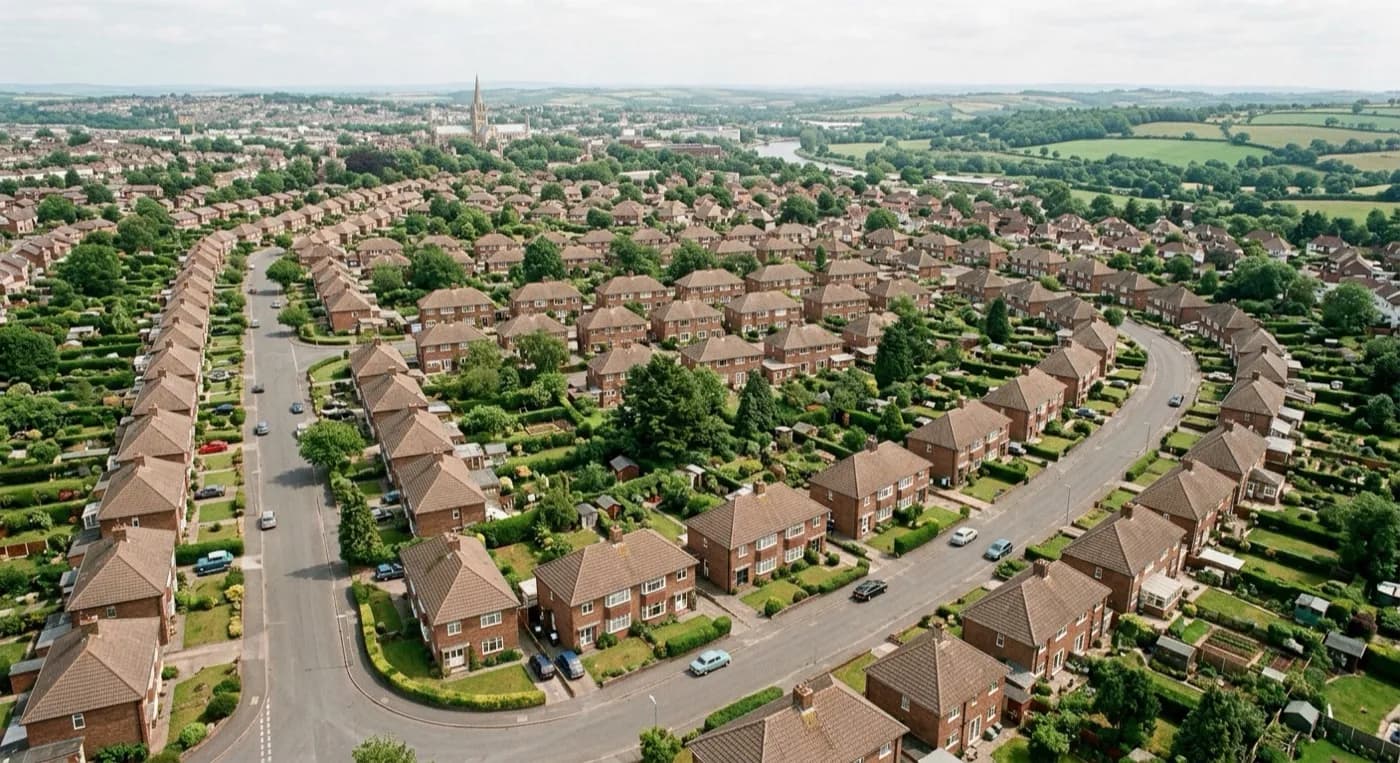
A roof inspection in Exwick, across the river from the city centre, where a riverside flood plain meets a hillside estate rising towards Exwick Heights.
River flats and a hillside estate
Exwick sits on the west bank of the Exe opposite the city centre, and like St Thomas further south it splits into two distinct kinds of ground: a low riverside strip, with some flats built on reclaimed former industrial land, and a hillside rising up towards Exwick Heights carrying 1930s semis lower down and larger post-war council estate housing higher up. The two halves need different things from an inspection.
The riverside stretch has changed use considerably over recent decades, from working industrial premises towards residential flats, and a number of those newer developments carry flat and low-pitched roof forms that would be unusual on the more traditional housing further up the hill.
Flat roofs by the river, wind exposure on the hill
On the riverside flat developments, flat roof membrane condition is the first priority, for the same reason it matters in St Thomas: low-lying ground with a history of flooding nearby means a separate, dated roof-level record is useful rather than assuming any water ingress must be ground level.
On the hillside estate above, the pattern is closer to Stoke Hill and Beacon Heath: more wind reaching the higher ground than the sheltered riverside, so ridge and verge condition on the post-war stock is worth checking as routine rather than reactive maintenance.
Communal roof areas on some of the riverside flat developments mean a single inspection visit can usefully cover an entire block rather than a single flat, with the findings shared across the residents or the managing freeholder as appropriate.
One district, two different reasons to book
Exwick is a useful example of why starting an inspection from the seven areas rather than from a single assumption about the district matters: a flat by the river and a semi near Exwick Heights are a short walk apart but face different roof risks, and a single generic checklist applied to both would either miss something on the flat roof or waste time checking ridge exposure that barely applies down by the water.
Booking it in
For a riverside flat development, it is worth clarifying whether the inspection is being booked by an individual leaseholder or a managing agent on behalf of the block, since that affects how the report is best addressed.
The hillside streets towards Exwick Heights are straightforward to reach, and a note on which part of the district the property sits in helps establish the right take off point in advance.
Where a property has changed use over the years, from industrial to residential along parts of the riverside, it is worth mentioning that history when booking, since a building converted for housing sometimes carries roof detailing left over from its earlier purpose that is worth checking on its own terms.
For a hillside semi, the same seasonal logic that applies in Stoke Hill and Beacon Heath is worth bearing in mind: checking after a stormy winter catches any wind-related ridge or verge movement while it is still a minor finding rather than a lost tile.
What the report is used for here
For a riverside flat, the report most often supports an insurance conversation kept deliberately separate from ground level flood evidence, giving a leaseholder or freeholder a roof-specific record to point to when a claim or a service charge discussion needs one.
For a hillside semi, the more common use is a straightforward maintenance decision, informed by the same wind exposure logic that applies across Exeter's higher northern and western districts.
Behind the survey
What Exwick clients are actually buying
Seven areas, checked in order
Tiles and slates, ridges and hips, valleys, flashings, chimney stacks, gutters and outlets, and any flat section, checked in the same order on every property where they apply.
CAA registered
Operator ID and Flyer ID held, plus the A2 Certificate of Competency. Every flight is planned to the rules that apply to the site, and the paperwork is available before the visit if a solicitor, agent or insurer needs it.
100 megapixel camera
A DJI Mavic 4 Pro with a Hasselblad camera and 6K video. The resolution is what lets the inspection stand off the building at a safe distance and still show a hairline crack in a single tile.
Insured with Coverdrone
Full commercial cover for the operation. Certificates go to solicitors, agents and insurers as a matter of course, without anyone having to chase for them.
Nearby
Also covered around Exwick
- St ThomasA roof inspection in St Thomas, where low ground by the Exe and a mix of Victorian terrace and later estate housing make a dated record worth having.
- Stoke HillA roof inspection in Stoke Hill, the hillside suburb below Stoke Woods where 1930s semis meet more recent infill on exposed, elevated streets.
- IdeA roof inspection in Ide, a conservation village on Exeter's western edge, with a concentration of thatched cob and stone cottages along one street.
See what's checked
Book an inspection in Exwick
Send the address and what is worrying you. Sam Hembury will come back with a fixed price and the next slot that suits the weather.