Devon · EX2
Roof inspection in Countess Wear
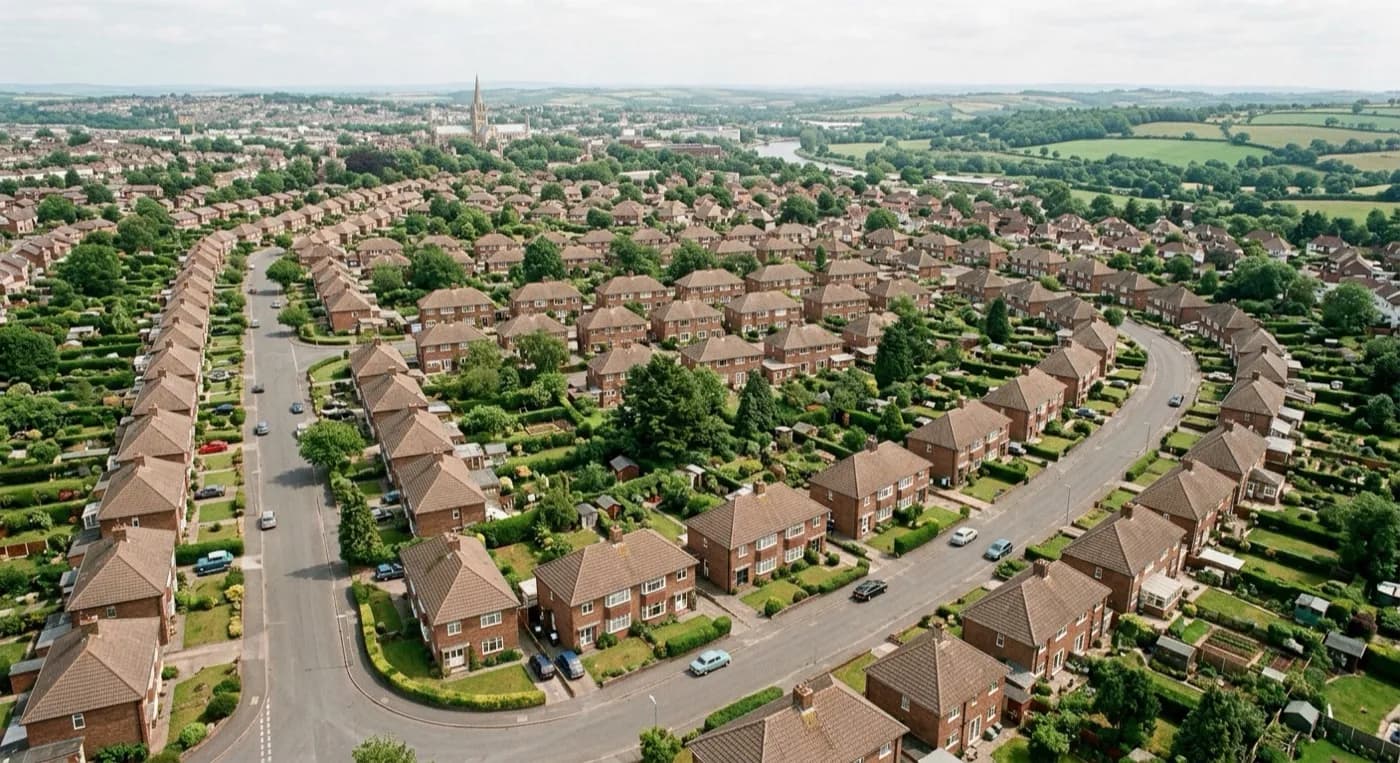
A roof inspection in Countess Wear, the lowest lying of Exeter's districts on the water, between the Exeter Ship Canal and the tidal Exe.
The lowest ground in the city
Countess Wear sits on the eastern bank of the Exe estuary south of the city, squeezed between the Exeter Ship Canal and the river itself, close to where the M5 crosses the water. It is, in a straightforward sense, the lowest lying of Exeter's residential districts, mostly 1930s and post-war semis and detached houses with some more recent riverside infill towards the Riverside Valley Park.
The canal and the river together mean water is rarely far from view in Countess Wear, and that proximity shapes how roofs here are best thought about, less in terms of storm exposure and more in terms of what a flood event on the ground does to an insurance claim that also needs to say something clear about the roof.
Flat roofs and gutters over ridge and hip
Given the ground it sits on, flat roof condition on any later extension or infill development is worth checking with particular care here, since standing water on a flat roof compounds an already flood-exposed position rather than being a separate, unrelated issue. Gutters and outlets matter for the same reason: a roof that cannot shed water efficiently is a real liability on ground this low, in a way it would be a minor inconvenience somewhere higher up the city.
The 1930s pitched stock still needs the usual ridge and valley checks, but on this particular ground they are the secondary concern rather than the first one.
Riverside infill properties towards the Valley Park are generally more recent and carry dry-fix ridge systems similar to Pinhoe's newest estate housing, worth checking with the same defects-period consideration where the property is young enough for that to apply.
A flood-adjacent record, not a flood survey
An inspection here is not a flood risk assessment and does not claim to be one. What it gives a Countess Wear owner is a dated, separate record of the roof's own condition, which is useful precisely because it is easy for a roof related question to get lost inside a wider flood conversation on ground this close to the water, when the two are actually asking different things.
Booking it in
Given the proximity to the canal and the river, it is worth booking an inspection at a point that is not immediately after a flood event if possible, so the roof level findings are not confused with any temporary ground level disruption still being dealt with.
Access along Countess Wear's residential streets is generally straightforward, and the Riverside Valley Park itself offers a useful, open reference point when confirming the exact location of a property near the water.
For a property backing onto the canal towpath, it is worth noting that boundary when booking, since it can affect where a lawful take off point is found compared with a property that only fronts onto a standard residential street.
Given how many Countess Wear properties are within a similar age bracket, a finding on one 1930s semi is a reasonable indication of what a neighbouring property of the same era might show, though the report still covers each address individually rather than assuming the pattern holds without checking.
What the report is used for here
As with Alphington and Exminster across the water, a Countess Wear report is most useful kept clearly separate from any flood related ground level documentation, giving an insurer two distinct pieces of dated evidence rather than one blurred account of what happened where.
For a buyer considering a property on this low ground, an inspection ahead of exchange gives a specific answer on roof condition that sits alongside, rather than inside, whatever flood risk information the searches themselves reveal.
Behind the survey
What Countess Wear clients are actually buying
Seven areas, checked in order
Tiles and slates, ridges and hips, valleys, flashings, chimney stacks, gutters and outlets, and any flat section, checked in the same order on every property where they apply.
CAA registered
Operator ID and Flyer ID held, plus the A2 Certificate of Competency. Every flight is planned to the rules that apply to the site, and the paperwork is available before the visit if a solicitor, agent or insurer needs it.
100 megapixel camera
A DJI Mavic 4 Pro with a Hasselblad camera and 6K video. The resolution is what lets the inspection stand off the building at a safe distance and still show a hairline crack in a single tile.
Insured with Coverdrone
Full commercial cover for the operation. Certificates go to solicitors, agents and insurers as a matter of course, without anyone having to chase for them.
Nearby
Also covered around Countess Wear
- TopshamA roof inspection in Topsham, where listed merchant houses and Dutch gables on narrow estuary streets carry more lead work than a standard Devon roof.
- WonfordA roof inspection in Wonford, home to the Royal Devon and Exeter Hospital, where post-war terraces sit alongside flat-roofed maisonette blocks.
- ExminsterA roof inspection in Exminster, a village beside the M5 and the Exe Estuary marshes, spanning old stone cottages and newer estate housing.
See what's checked
Book an inspection in Countess Wear
Send the address and what is worrying you. Sam Hembury will come back with a fixed price and the next slot that suits the weather.